
Best Restaurants in Vienna, Austria: Two Three-Star Kitchens and One Very Legal Cutlet
The best restaurants in Vienna, Austria are unusually easy to rank and unusually easy to get wrong, which is a combination the city seems to enjoy. Vienna has two restaurants with three MICHELIN stars. Most of what you will read says it has one. The city also serves the most famous breaded cutlet in Europe under a name that, legally speaking, it is not allowed to use for it.
The direct answer first, because you may be standing outside somewhere with a menu in the window. In the MICHELIN Guide Austria 2026, Vienna holds 26 stars across 18 restaurants. Two of those hold three stars: Steirereck im Stadtpark, in the Stadtpark itself, and Amador, out in the wine country of the 19th district. Four hold two stars. Twelve hold one.
Everything after this is the part that actually helps: which of those to book, the three dishes worth planning a day around, what the coffee house is really listed as, and why searching for restaurants in Vienna keeps showing you an inn in Massachusetts.
Vienna has two three-star restaurants, and most of the internet knows about one
The MICHELIN Guide Austria 2026 covers 420 restaurants. Of those, 101 hold stars: two with three stars, 19 with two stars, and 80 with one, which comes to 124 stars in total. There are also 61 Bib Gourmands. Those numbers come from MICHELIN's own 2026 Austria page and they reconcile exactly against the Austrian National Tourist Office release, which is the check worth doing on any star claim before you repeat it.
Both of Austria's three-star restaurants are in Vienna. Steirereck im Stadtpark, the Reitbauer family's kitchen in the city park in Landstraße, and Amador, Juan Amador's dining room in Döbling, out where the vineyards start. That is the whole list. A country of nine million has two three-star restaurants and both are a tram ride apart.
Here is where almost every guide goes wrong, including, until recently, ours. Steirereck spent years at two stars. Amador was, for that whole period, correctly described as Vienna's only three-star restaurant. Then on 21 January 2025, in the first MICHELIN guide to cover all of Austria rather than just Vienna and Salzburg, Steirereck was promoted. One announcement, one afternoon, and two separate sentences that had been true for years stopped being true at the same moment: Steirereck was no longer a two-star, and Amador was no longer the only three-star.
That is a nastier kind of stale fact than a closure, because nothing visibly broke. The restaurant did not move, did not rename, did not shut. If you check whether Steirereck has MICHELIN stars, the answer is still yes. The old claim is not false so much as short. The only thing that catches it is counting: if a page names one three-star restaurant in Vienna and the guide says there are two, the page is wrong before you have looked up a single restaurant.
| Level | In Vienna | Who |
|---|---|---|
| Three stars | 2 | Steirereck im Stadtpark (Landstraße), Amador (Döbling) |
| Two stars | 4 | Konstantin Filippou (Innere Stadt), Silvio Nickol (Innere Stadt), Mraz & Sohn (Brigittenau), Doubek (Josefstadt, new in 2026) |
| One star | 12 | Spread across the city, several outside the 1st district |
| Total | 18 restaurants, 26 stars | MICHELIN Guide Austria 2026 |
One habit that will save you repeatedly: name the edition. Not "Michelin-starred" but "two stars in the 2026 Austria guide." Rankings republish annually under the same name and often the same web address, so last year's coverage frequently outranks this year's. We ran into the same problem in Seoul, where guides published this year still list a restaurant that closed at the start of 2023. If you are curious which cities actually top the star count, we counted them properly rather than repeating the usual list.
Wiener Schnitzel is a legal term, and Vienna's most famous schnitzel is not one
In Austria, Wiener Schnitzel means veal. That is not a preference or a purist opinion, it is how the name may be used on a menu. A pork cutlet prepared the identical way is sold as Schnitzel Wiener Art, which translates roughly as schnitzel in the Viennese style, and which is the culinary equivalent of "sparkling wine made in the traditional method."
Now the fun part. Figlmüller on Wollzeile, open since 1905 and the single most searched restaurant name in Vienna, is famous for a schnitzel the size of a bin lid. It is pork. Their own menu is completely straight about this: the dish is listed as the Figlmüller-Schnitzel, made of pork, their original since 1905, at 21.90 euros. They did not name it after the city. They named it after themselves, which is precisely the move a restaurant makes when it knows it cannot use the other name.
At their second address on Bäckerstraße, opened in 2001, you can order the veal one, listed as Wiener Schnitzel, at 28.90 euros. So the legal distinction is sitting right there on one menu with a seven euro price difference attached to it. Most visitors eat the pork, love it, and go home saying they had the best Wiener Schnitzel of their life. They had the best Schnitzel Wiener Art of their life. Nobody is going to stop you at passport control.
What to look for, whichever meat you pick. The cutlet should be pounded thin enough to hang over the edge of the plate, and the breadcrumb coat should be blistered and lifted slightly away from the meat rather than shrink-wrapped to it. That gap is the tell. It comes from frying in enough fat that the schnitzel floats and the crumb puffs instead of pressing flat. A small cutlet sitting in the middle of a plate under a tight orange shell is a breaded cutlet. It may be delicious. It is not the thing you came for.
Lemon, yes. The traditional accompaniment is potato salad or parsleyed potatoes, and in Vienna the potato salad is dressed with vinegar and stock rather than mayonnaise, which surprises people who were bracing for something heavier.
Tafelspitz arrives in a copper pot, and there is an order to it
If the schnitzel is Vienna's most famous dish, Tafelspitz is its most Viennese. Boiled beef sounds like a punishment and is in fact one of the great pieces of European cooking, which tells you something about how badly translation serves this city.
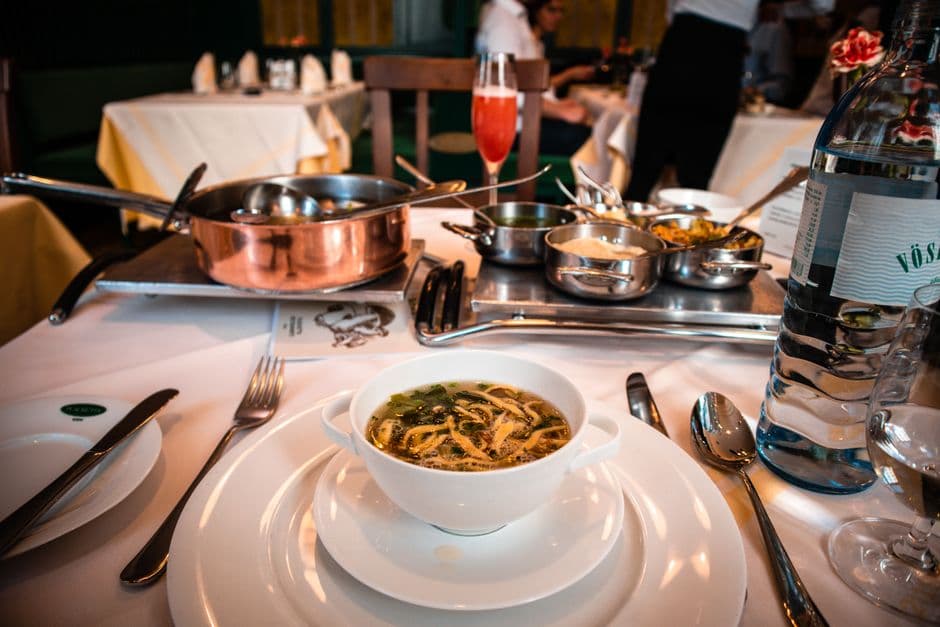
Plachutta is the reference kitchen for it, and their own explanation is worth reading before you sit down, because they serve 13 different cuts and print charts showing where on the animal each one comes from. Tafelspitz itself is one specific cut, from the upper part of the rear leg of a young ox. Order "Tafelspitz" and you get that cut. Order one of the other twelve and you get a different texture entirely, which is the whole point of the exercise and the reason regulars have opinions.
It arrives as a copper pot of broth on a stand, with the beef and root vegetables in it, a marrow bone, and a small fleet of side dishes: apple horseradish, chive sauce, roast potatoes, and toasted dark bread. The sequence matters and almost nobody gets told it.
First, drink the broth as a soup. It is served to you in a cup and it is not a garnish. Second, scoop the marrow out of the bone, spread it on the dark toast, salt and pepper it, and eat it with your fingers. Third, and only third, the beef, with the apple horseradish and the chive sauce. Doing it in that order is the difference between a two-hour lunch and a plate of wet beef, and it costs nothing to know.
The chive sauce deserves a word. It is thickened with bread and hard-boiled egg rather than cream, which is why it tastes lighter than it looks and why people who claim not to like chives finish it.
The coffee house is on a heritage list, and it is not the list you think
Viennese coffee house culture was inscribed in 2011 on Austria's national inventory of intangible cultural heritage, which is maintained by the Austrian UNESCO Commission. Read that sentence twice, because it is not what almost every article says. It is not on UNESCO's international Representative List, and it is emphatically not a World Heritage Site. Those are three different things and guides collapse them into "UNESCO protected" constantly.
This is becoming a pattern in our research. When we wrote about where to eat in Naples we found the same shape: the 2017 UNESCO listing there covers the art of the pizza maker and not the pizza. The listing is always narrower than the retelling, and always in the same direction. If you want the rest of the cities we have mapped this way, they are all on our destinations page.
What is actually listed is a set of social practices, and the commission's own description of the place is better than anything a travel writer has managed: somewhere "in which time and space are consumed, but only the coffee is listed on the bill." The physical markers it names are small marble-topped tables, Thonet bentwood chairs, alcoves, newspaper tables, and interiors in the Historicist style.
Practically, two things follow. First, sitting for three hours with one coffee is not rude, it is the entire product. Second, order by name rather than by size, because the names are the menu:
| Order this | You get |
|---|---|
| Melange | Espresso with hot milk and a cap of foam, the default Viennese coffee |
| Verlängerter | Espresso lengthened with hot water, closest to a long black |
| Kleiner Brauner | Single espresso with a little milk or cream served alongside |
| Einspänner | Double espresso in a glass under a thick layer of whipped cream |
Your coffee should arrive on a small tray with a glass of water beside it. That tray is the tell for the real thing far more reliably than the decor, which any cafe can buy. The water is free, it gets refilled, and refusing it confuses everyone.
As for cake: the Sachertorte question has a legal answer, which is very Vienna. Hotel Sacher sued Demel in 1954 over the name. They settled out of court in 1963, with Sacher keeping the right to call its cake The Original Sachertorte and Demel keeping the right to finish its own with a triangular seal. So both are legitimate, they are genuinely different cakes, and the correct response to being asked which is better is to eat both and remain diplomatically undecided.
Where to eat in Vienna, by district
Vienna numbers its districts, from the 1st in the center outward to the 23rd, and locals give directions in numbers. It is a genuinely useful system once you stop resisting it, which takes most visitors about a day and a half.
| District | Known for | Worth knowing |
|---|---|---|
| 1st, Innere Stadt | Figlmüller, Plachutta Wollzeile, Konstantin Filippou, Silvio Nickol | Dense with visitors and also where several of the real institutions genuinely are. Do not write it off. |
| 3rd, Landstraße | Steirereck im Stadtpark | The park setting is half the meal. Book well ahead. |
| 19th, Döbling | Amador, and the Heuriger wine taverns of Grinzing and Nussdorf | The one district where dinner and a vineyard are the same trip. |
| 20th, Brigittenau | Mraz & Sohn | Two stars in a residential district almost no visitor reaches. |
| 8th, Josefstadt | Doubek, plus small neighborhood dining rooms | Leafy, walkable, and the current answer to where Viennese people eat. |
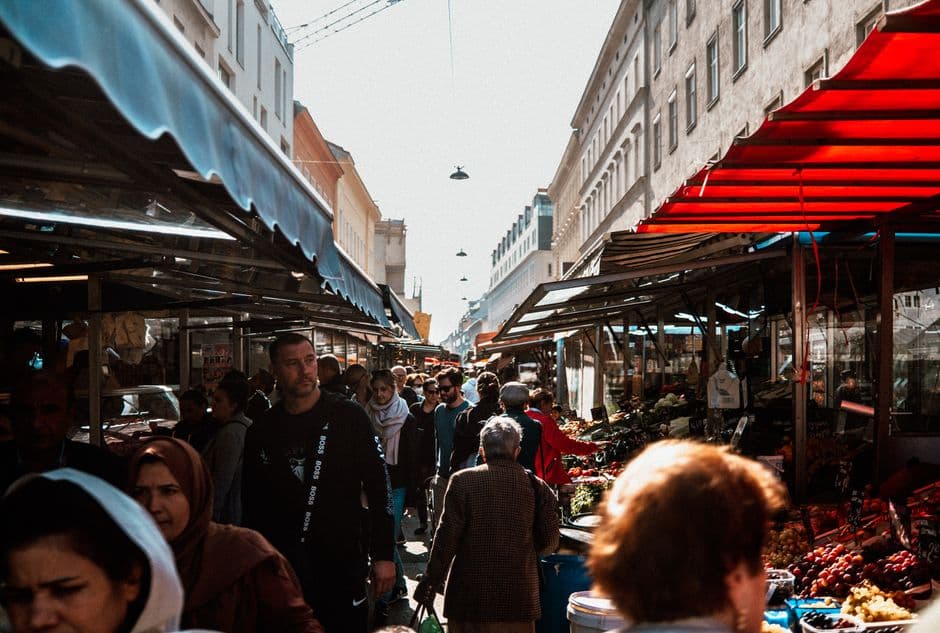
| 2nd, Leopoldstadt | Karmelitermarkt | A working market with food stalls, best on a Saturday morning. |
| 4th and 6th, along the Wienzeile | Naschmarkt | Vienna's big market. Produce and delicatessens at one end, sit-down stalls at the other. |
A pattern worth noticing in that table: two of Vienna's six highest-rated kitchens are nowhere near the old town. Mraz & Sohn holds two stars in Brigittenau, a district whose main claim to tourism is that the train sometimes passes through it. If you are building an itinerary purely around the 1st district you are skipping half of the good part.
If you like this way of navigating a city by district rather than by list, the same approach works well in Budapest and Prague, the other two Habsburg capitals where the good cooking has quietly moved out of the center.
What to order, and what each thing actually is
Austrian menu German is not hard, but it is specific, and the English translations on tourist menus are frequently worse than useless. This is the short version.
| On the menu | What arrives |
|---|---|
| Wiener Schnitzel | Breaded veal cutlet. The protected name, the higher price. |
| Schnitzel Wiener Art | The same thing made with pork. What most visitors actually eat. |
| Tafelspitz | Boiled beef in broth, served in a copper pot with marrow, horseradish and chive sauce. |
| Backhendl | Breaded fried chicken, the schnitzel technique applied to a bird. |
| Gulasch | Beef in paprika sauce. Thicker and less soupy than the Hungarian version. |
| Kaiserschmarrn | Shredded, caramelized pancake with stewed plums. Frequently ordered as a main by people who regret nothing. |
| Apfelstrudel | Apple strudel, and the pastry should be thin enough to read through. |
| Sachertorte | Dense chocolate cake with apricot jam under the glaze. Order it with unsweetened whipped cream. |
One more piece of table etiquette. Tipping in Vienna is done by rounding up and telling the server the total you want to pay as you hand over the money, rather than leaving coins on the table afterwards. Say the number. It feels abrupt the first time and then it feels efficient.
Why searching for Vienna restaurants keeps showing you Massachusetts
This is the section nobody else writes, and it is the one that will save you the most time. Vienna has a search problem, and it is not the one you would guess.
We keep a file of the search phrases people actually type that combine "Vienna" with "restaurant." It runs to 63 phrases and about 26,810 searches a month. At least 16 of those phrases, worth 6,530 searches a month, are not about Austria at all. They are about businesses in the United States. That is a quarter of the file, and a wider reading that includes a few more probable matches takes it to roughly 28 percent.
Two clusters do nearly all of it. The first is Vienna, Virginia, a suburb of Washington DC, which contributes searches for Kiin Imm Thai on Avenir Place, Clarity on Maple Avenue East, Maple Ave Restaurant on Maple Avenue West, and Sweet Ginger on Branch Road. Note how many of those sit on Maple Avenue, which is Vienna VA's main street, and which is why the phrase "maple avenue restaurant vienna" is a real search term with 590 people a month behind it.
The second cluster is stranger and, for our purposes, much worse. There is a single establishment in Southbridge, Massachusetts called the Vienna Restaurant and Historic Inn. One building. It accounts for ten separate phrases in the file and about 2,250 searches a month, because people spell it ten different ways: with and without "historic," with and without "southbridge," with "ma" on the end, with an ampersand, with the words in either order.
Here is the part that matters if you have ever picked a topic by looking for the easy keywords. Across the whole file, US businesses are about a quarter of the volume. But if you filter to only the phrases that look easy to rank for, the difficulty score of 25 or below, they jump to 37 percent of the volume, and by the wider reading 44 percent. The junk is concentrated precisely where anyone hunting for an easy win would look.
Sort the file by easiest first and the top eight are: an ambiguous one, then the Massachusetts inn five times, with exactly two genuine Vienna, Austria phrases mixed in. Someone optimizing purely for low difficulty would write a beautiful, carefully researched article about a nineteenth-century inn in Worcester County.
| Search phrase | Difficulty | Monthly searches | Which Vienna |
|---|---|---|---|
| vienna restaurant week | 11 | 320 | Both, genuinely |
| vienna restaurant & historic inn | 16 | 260 | Southbridge, Massachusetts |
| rathauskeller restaurant vienna | 18 | 320 | Austria |
| vienna restaurant and historic inn southbridge | 18 | 260 | Southbridge, Massachusetts |
| vienna restaurant southbridge | 21 | 170 | Southbridge, Massachusetts |
| best restaurant vienna | 22 | 140 | Austria |
| best restaurants vienna austria | 24 | 320 | Austria, unambiguously |
The top row is the one we enjoyed most. "Vienna restaurant week" is the easiest phrase in the entire file, and it is easy because it is ambiguous rather than because it is available. Both Viennas run a restaurant week, three weeks apart, in the same month. Vienna, Virginia ran its fifth annual one from 27 February to 8 March 2026. Vienna, Austria ran its Restaurantwoche from 16 to 22 March 2026, with set menus from 19.50 euros at lunch. The search results are a blend of two unrelated events, which splits the competition and makes the phrase look winnable when really it is just confused.
The fix for you as a traveler is one word. Add "austria." Only four phrases in the entire file contain it, carrying 6.3 percent of the volume, which means almost nobody does it and the people who do get clean results immediately.
Curiously, the city adjective works too, which is not usually the case. When we looked at the same problem in Seoul, adding "Korean" made things worse, because Korean is the name of a cuisine served everywhere on earth and the adjective pulls in restaurants in Texas. "Viennese" is not a cuisine anyone serves outside Vienna. So "viennese restaurants in vienna," which sounds redundant to the point of comedy, is actually a precise search. Sometimes the silly phrasing is the correct one.
Best restaurants in Vienna: common questions
The questions we get asked most, answered with the edition and the date attached, because that is the only way a restaurant answer stays useful for more than a season. All figures here were correct at the time of writing in September 2026.
Go and eat the schnitzel. Order it pork, call it whatever you like, and take the long way back through the park so you have somewhere to put it. We already saved you the good addresses, which means the only argument left is which cake, and honestly there is no winning that one.
Best restaurants in Vienna: common questions
- What are the best restaurants in Vienna, Austria?
- At the top, Vienna has two three-MICHELIN-star restaurants in the 2026 Austria guide: Steirereck im Stadtpark in Landstrasse and Amador in Doebling. The two-star tier is Konstantin Filippou and Silvio Nickol in the Innere Stadt, Mraz and Sohn in Brigittenau, and Doubek in Josefstadt, which was new in 2026. For the classics rather than the stars, Figlmueller on Wollzeile for schnitzel since 1905 and Plachutta on Wollzeile for Tafelspitz. For a market meal, the Naschmarkt along the Wienzeile or the Karmelitermarkt in Leopoldstadt.
- How many Michelin star restaurants are in Vienna?
- Eighteen, holding 26 stars between them, in the MICHELIN Guide Austria 2026: two with three stars, four with two stars and twelve with one star. Across Austria as a whole the guide lists 101 starred restaurants holding 124 stars, plus 61 Bib Gourmands, out of 420 restaurants in the selection. The figure most guides get wrong is the three-star count, because Steirereck was promoted from two stars to three on 21 January 2025 and a great deal of writing predates that.
- Does Vienna have a three-Michelin-star restaurant?
- It has two, and they are the only two in Austria. Amador, in Doebling, held three stars first and was for years correctly described as the city's only three-star restaurant. Steirereck im Stadtpark joined it on 21 January 2025, in the first MICHELIN guide to cover all of Austria rather than only Vienna and Salzburg. Any page naming just one of them is describing the situation before that date.
- Is Wiener Schnitzel made from veal or pork?
- Veal. In Austria the name Wiener Schnitzel is reserved for veal, and the identical dish made with pork is sold as Schnitzel Wiener Art, meaning schnitzel in the Viennese style. This matters at Figlmueller, Vienna's most famous schnitzel restaurant, because its signature dish is pork: the menu lists it as the Figlmueller-Schnitzel made of pork, their original since 1905, at 21.90 euros. Their Baeckerstrasse address also serves a veal Wiener Schnitzel at 28.90 euros, so both versions are available and the price gap is the legal distinction.
- What is Tafelspitz and how do you eat it?
- Boiled beef in broth, and it is Vienna's most characteristic dish. It arrives as a copper pot of broth holding the beef and root vegetables, with a marrow bone and separate dishes of apple horseradish, chive sauce, roast potatoes and toasted dark bread. Eat it in three stages: drink the broth first as a soup, then spread the marrow on the toasted dark bread with salt and pepper and eat it with your fingers, then the beef with the two sauces. Plachutta serves 13 different cuts and prints charts showing where on the animal each comes from, so ordering Tafelspitz specifically gets you the cut from the upper part of the rear leg.
- Is Viennese coffee house culture a UNESCO World Heritage Site?
- No, and this is the single most repeated error about Vienna. Viennese coffee house culture was inscribed in 2011 on Austria's national inventory of intangible cultural heritage, which is maintained by the Austrian UNESCO Commission. That is not UNESCO's international Representative List and it is not the World Heritage list, which covers places rather than practices. What is listed is a set of social practices, described by the commission as a place in which time and space are consumed but only the coffee is listed on the bill.
- What is the difference between Sacher and Demel Sachertorte?
- A court case. Hotel Sacher sued Demel in 1954 over the right to the name and the two settled out of court in 1963. Sacher kept the right to call its cake The Original Sachertorte, and Demel kept the right to finish its own with a triangular seal. Both are legitimate and they are genuinely different cakes, differing mainly in how many layers of apricot jam sit under the chocolate glaze.
- Why do searches for Vienna restaurants show results in the United States?
- Because two American places share the name. Of 63 search phrases combining Vienna with restaurant, at least 16 of them and 6,530 of the 26,810 monthly searches name a US business rather than the Austrian city. One cluster is Vienna, Virginia, a Washington DC suburb, including Kiin Imm Thai, Clarity and Maple Ave Restaurant. The other is a single building, the Vienna Restaurant and Historic Inn in Southbridge, Massachusetts, which alone accounts for ten phrases and about 2,250 searches a month because people spell its name ten different ways. The distortion is worst among the phrases that look easiest to rank for. Adding the word austria fixes it, and so does the adjective viennese, which unlike Korean or Thai is not the name of a cuisine served elsewhere.