
Best Restaurants in Seoul, South Korea: One Three-Star, and the Lists That Are Out of Date
The best restaurants in Seoul are easier to find than the internet makes them look, because most of what is written about the top of the scene is two guide editions out of date. Seoul has exactly one restaurant with three MICHELIN stars. Guides published this year still name three. This page gives the current list with the edition attached, the handful of cheap meals that beat most of the expensive ones, and the one search habit that stops sending you to Texas.
The direct answer first. In the MICHELIN Guide Seoul & Busan 2026, announced in March 2026, Seoul has 42 starred restaurants: one with three stars, ten with two, and 31 with one. The three-star is Mingles, in Cheongdam-dong. Gaon, which held three stars for seven straight years and still appears on current lists, has been closed since the start of 2023. La Yeon, also still described as a three-star in plenty of 2026 writing, has two. Mosu Seoul, the same, has two.
Everything after this is the useful version of that: what to book, what to eat instead of booking, and how the city expects you to behave at the table.
Seoul has one three-star restaurant, and the guides still say three
This is the single most reliably wrong fact about dining in Seoul, and it is wrong in a way that costs money, because people book against it.
The MICHELIN Guide arrived in Korea in 2016. For most of the decade that followed, Seoul had two or three restaurants at the top level, and the names cycled. Gaon, the royal court cuisine room on Dosan-daero in Sinsa-dong run by the ceramics house Gwangjuyo, held three stars for seven consecutive years from the guide's first Korean edition. La Yeon, on the 23rd floor of The Shilla, held three for years. Mosu Seoul, chef Sung Anh's kitchen, took a third star for the 2023 and 2024 editions.
All three of those sentences are in the past tense now, and only one of the changes was announced loudly enough to travel.
| Restaurant | What guides often say | 2026 guide |
|---|---|---|
| Mingles, Cheongdam-dong | Three stars | Three stars. Correct. |
| Gaon, Sinsa-dong | Three stars, royal court cuisine | Closed since 1 January 2023 |
| La Yeon, The Shilla | Three stars | Two stars |
| Mosu Seoul, Hannam-dong | Three stars | Two stars |
Gaon is the one that matters most, because it is not a demotion, it is a closed door. It shut on 1 January 2023, stated at the time as a pause for the kitchen to reorganize and research, and it has not reopened since. It is still listed as a working two or three-star room on guides published in 2026, including at least one that advertises itself as the complete guide to the current selection. If you have a Gaon dinner on a Seoul itinerary, it is not a dinner.
Mosu is the interesting one. It held three stars in 2023 and 2024, closed during 2024 and so was not assessed for the 2025 edition, and reopened in Hannam-dong in March 2025. The 2026 guide brought it back at two stars. That is not the same event as losing a star and it reads differently if you know which one happened, which is the whole argument for putting an edition year next to any star claim.
The current ten two-star rooms include La Yeon and Mosu Seoul alongside Jungsik, where Yim Jung-sik has been building the case for modern Korean fine dining since before the guide existed here, plus Soigne, Kwonsooksoo, Mitou, alla prima, and Sosuheon, a sushi room newly promoted to two for 2026. One-star Seoul is where the interesting churn is: Gagen, Hakushi, Restaurant Jueun, Collage, Giwagane, San and Sushi Kanesaka are all in the 2026 selection.
One more correction worth having, because it appears in a lot of Seoul copy. Mingles is frequently described as the number one restaurant in Asia for 2024. It was not. Asia's 50 Best Restaurants 2024 was won by Sezanne in Tokyo. Mingles was named the best restaurant in Korea that year, which is a real and different thing. Its actual standing today is stronger than the garbled version: it is fourth in Asia's 50 Best Restaurants 2026, the highest-placed Korean restaurant on the list.
If a starred dinner is the point of the trip, book Mingles and accept that the lead time is long. If it is one nice evening among several, the two-star tier in Seoul is unusually deep for a city this size and considerably easier to get into.
Korean barbecue is a room, not a recipe
The most common way to eat badly in Seoul is to eat Korean barbecue in a place that is doing an impression of it. The tell is architectural, not culinary, and you can check it from the doorway before you sit down.
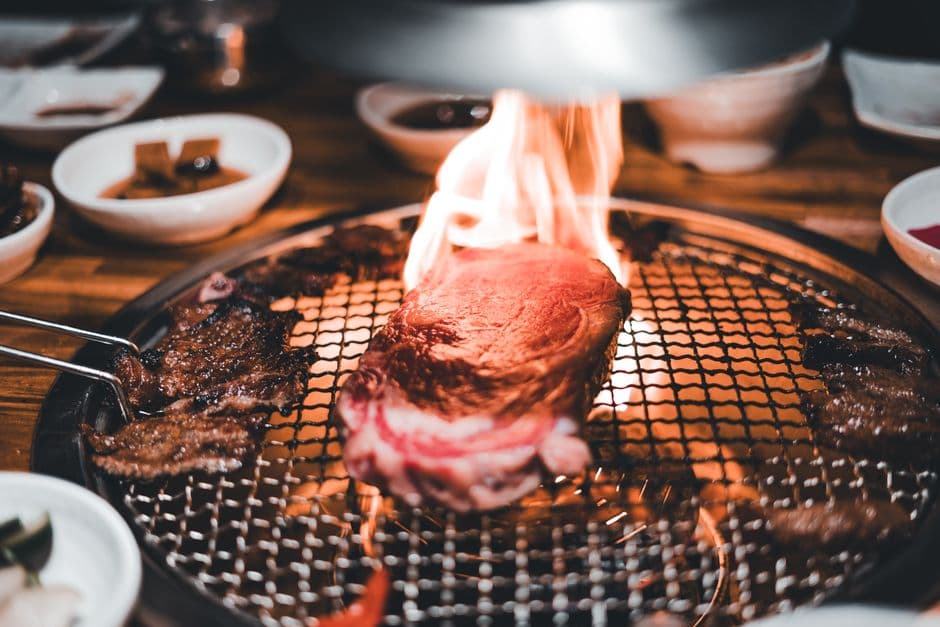
A barbecue house has the grill set into the table, a heat source underneath it, and an extraction hood on a duct hanging over every table. Charcoal arrives in a metal bucket and gets dropped into the well. Someone who works there, not you, generally manages the meat: turns it, cuts it with shears, moves the cooked pieces to the cooler rim. If the meat comes out pre-marinated in a pan, if the grill is a plug-in plate carried to the table, if there is no hood, you are in a Korean-American restaurant, which is a perfectly good thing to be and is not what you came for.
The other half of the form is what happens after the meat is cut. You are not eating it off the grill with rice on the side. You are building ssam: a leaf of lettuce or perilla, a piece of pork or beef, a smear of ssamjang, a sliver of raw garlic or a piece of grilled kimchi, folded and eaten in one go. Ordering is by cut and by weight, not by dish. Samgyeopsal is pork belly, moksal is pork neck and is the better order more often than people admit, and galbi is short rib.
For pork, Geumdwaeji Sikdang in Jung-gu is the version that does not require an argument: a Bib Gourmand in the current guide for samgyeopsal and moksal, which is roughly the highest compliment the guide pays to a grill house. At the other end, one-star and two-star Seoul includes serious beef rooms where the hanwoo is aged in house and cut to order, and where the barbecue format is kept and the price is not.
Three cheap meals that beat most of the expensive ones
Seoul rewards the low end of the market more than almost any city with a comparable fine-dining scene. These three are institutions, all cheap, all better than their reputation suggests.
Myeongdong Kyoja is the answer to a search a lot of people run without knowing the name they are looking for. It opened in 1966 as Myeongdong Kalguksu and took the Kyoja name, the Sino-Korean word for dumpling, in 1978. The main room is at 29 Myeongdong 10-gil and the menu is four dishes: kalguksu, mandu, bibimguksu and kongguksu in season. It has been a MICHELIN Bib Gourmand since the Korean guide began, and the Seoul Metropolitan Government lists it as Future Heritage. Order the kalguksu, eat the garlic kimchi that comes with it, and understand that the kimchi is the reason people talk about the place.
Hwangsaengga Kalguksu in Bukchon is the other kalguksu argument, and it is a different dish in practice: a beef bone broth, soft hand-cut noodles, and oversized dumplings assembled in front of you. Also a Bib Gourmand in the 2026 selection. There is a queue and it moves.
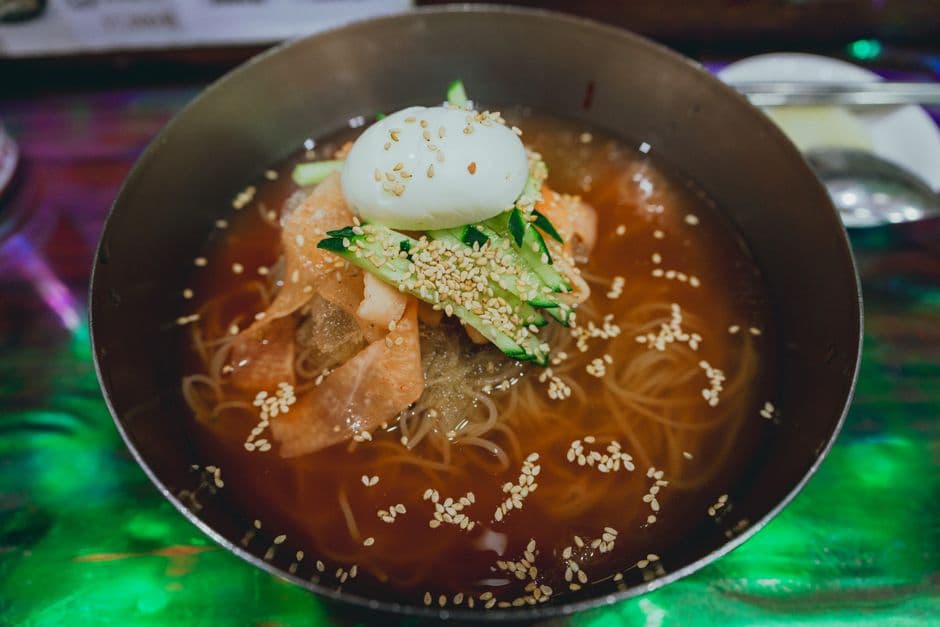
Woo Lae Oak has been going since 1946 and serves Pyongyang-style naengmyeon, which is the version with almost nothing in it: buckwheat noodles, a clear chilled beef broth, restraint as the entire point. It is at 62-29 Changgyeonggung-ro in Jung-gu, not in Jongno where half the internet puts it. First-timers usually find Pyongyang naengmyeon underwhelming and then think about it for a week. Do not add vinegar and mustard until you have tasted the broth on its own.
The 2026 guide added five new Bib Gourmands in Seoul, which is where to look if you want the current version of this list rather than the one everyone has already written up: 3rd Samgyetang, Gosari Express, Sobakeeri Suzu, Andeok and Oilje.
Banchan is not a starter, and four other rules of the table
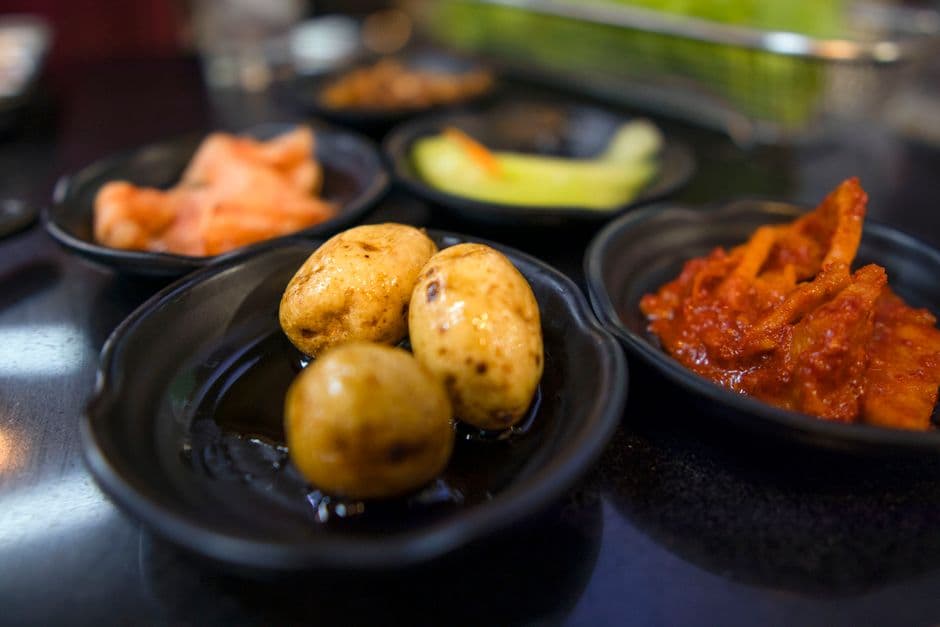
Banchan is included and it is refilled. The small dishes that arrive before you have ordered anything are not appetizers and are not charged for. A normal spread is six or more. You ask for more of the ones you like and nobody thinks anything of it. Visitors routinely eat one dish of each politely and then wonder why the meal felt small.
Naengmyeon is cold on purpose. It is not a summer novelty or a cooled-down soup. Mul naengmyeon is noodles in chilled broth, bibim naengmyeon is the same noodles in a chili-gochujang sauce with no broth, and in barbecue houses a bowl of it is the conventional end of the meal rather than the start.
Dolsot bibimbap and bibimbap are two dishes. The stone bowl version is served in a bowl hot enough to crisp the rice against the side while you mix, and that crust is the reason to order it. The room-temperature version in a metal or ceramic bowl is a different, lighter dish. Menus in Seoul distinguish them. English-language write-ups usually do not.
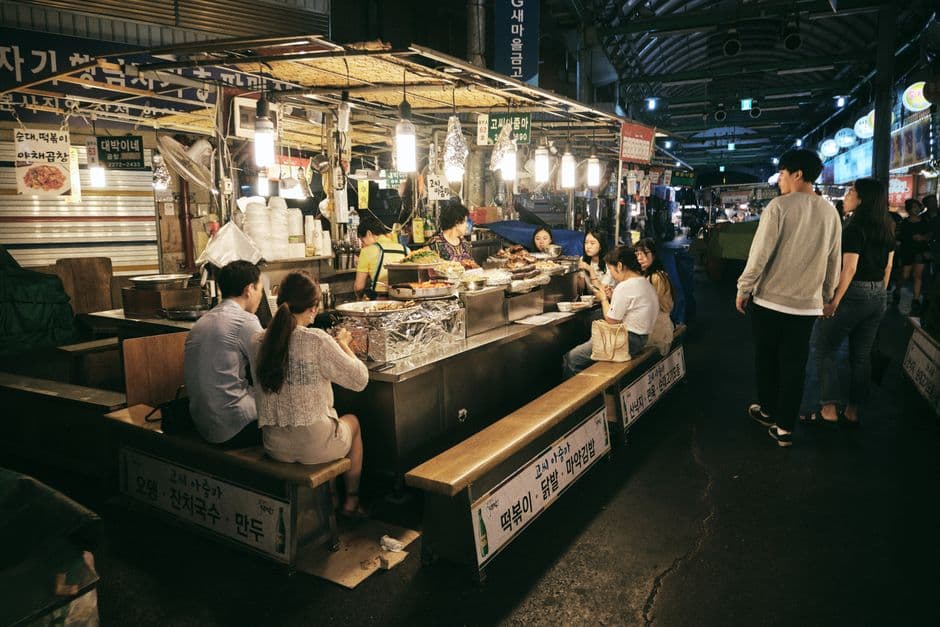
You order by the table, not by the head. Most Korean restaurants are built around shared dishes with a two-portion minimum, which is the single hardest thing about eating alone in Seoul. The workaround is the category of restaurants that exist for solo diners: noodle houses, gukbap shops, gimbap counters, and the market stalls.
Nobody pours their own drink. If soju or beer is on the table, you fill other people's glasses and they fill yours, two hands on the bottle when the other person is older. It is the one piece of etiquette that visitors get wrong within the first ten minutes and the one that is most obviously noticed.
Where to eat in Seoul, by neighborhood
Seoul is too big to treat as one place. It is roughly the population of London in a footprint with a river through the middle, and the difference between north and south of the Han is not a mood, it is a different set of restaurants at different prices.
| Area | What it is for | What to expect |
|---|---|---|
| Cheongdam and Apgujeong | The starred tier | Mingles, Jungsik and most of the tasting-menu rooms. Book weeks out, dress up. |
| Hannam-dong and Itaewon | Modern, international, expensive | Mosu Seoul sits here. Small rooms, chef-driven, a lot of wine lists. |
| Euljiro | Old print-shop district turned drinking district | Grilled meat and pots of stew at plastic tables in alleys, late. |
| Hongdae | Student money, cheap and loud | Fried chicken, tteokbokki, barbecue by the portion, open very late. |
| Seochon and Bukchon | Daytime eating near the palaces | Kalguksu, hanjeongsik, small traditional rooms. Closes early. |
| Mapo and Yeonnam | Where people actually eat on a weeknight | Pork galbi, makgeolli, neighborhood places with no English menu. |
| Jongno and the markets | Street food and solo eating | Bindaetteok, mayak gimbap, sundae, mandu. Cash helps. |
The practical version: if you have three nights, spend one south of the river on something booked, one in Euljiro or Mapo on something not booked, and one at a market counter. That ordering also matches the price curve, which is steeper here than in Tokyo, where the middle of the market is much thicker.
Restaurants in Hongdae deserve their own warning. The area has the highest density of Korean food in the city per square meter and the lowest median quality, because it is built for students at midnight rather than for dinner. It is genuinely good for fried chicken, for tteokbokki, and for barbecue where price beats grade. It is not where to spend a real budget.
Seoul has two airports and one of them is not in Seoul
Worth knowing before you plan a last meal around a flight. Gimpo International Airport is inside Seoul, in Gangseo-gu, about 16 kilometers from the center. Incheon International Airport, which is where almost every long-haul flight lands, is not in Seoul at all. It is in Incheon, a separate metropolitan city on Yeongjong Island, about 48 kilometers west of central Seoul.
The practical consequence is a timing one. Searching for restaurants near Seoul airport returns two different places an hour apart by train. If your flight is from Incheon, the last proper meal happens in the city with the airport train ride budgeted afterwards, not near the terminal. If it is from Gimpo, you are still in Seoul and the Mapo and Yeonnam options above are reachable.
Why searching for Seoul restaurants sends you to Lubbock, Texas
This will happen to you. Seoul is a city of nearly ten million people and it is also, in the United States, a restaurant name. Search engines cannot tell the two apart, and the volume is not close to evenly split.
We pulled the keyword file for this page before writing it. Of 99 search phrases combining Seoul with restaurant, 33 of them, carrying 20,650 of the 53,330 monthly searches in the file, name a business rather than the city. Seoul Garden, at 5,400 searches a month, is the joint-largest phrase in the entire file and it is a restaurant name used across the United States. Below it: New Seoul, Seoul House, Seoul Kitchen, Enjoy Seoul, Road to Seoul, Seoul Sausage, and named American towns. Seoul Korean Cuisine has been in Lubbock, Texas since 2008. Seoul Korean Restaurant is on Troy-Schenectady Road in Latham, New York. Count the borderline phrases too, the ones that could plausibly be either, and the share passes 46 percent.
This is the second city we have written up where the name is a restaurant brand rather than a rival place. The first was Istanbul. Naples and Valencia are the other shape, where the competition is a different real city.
The fix is the same fix as those three, with one refinement that matters here more than anywhere. Name the country. But name it as a noun, not as an adjective. Searching restaurants in seoul south korea works. Searching seoul korean restaurant does the opposite, because Korean is the adjective every Korean restaurant on earth puts on its sign: that phrase carries 3,600 searches a month and almost none of them are about the city. The same trap is waiting on Thai, Vietnamese, Mexican and Japanese.
One number makes the point. Four phrases in the whole 99-row file contain the words south korea. Together they are 1,290 searches a month, about 2.4 percent of the volume. The version of the search that actually works is the one almost nobody runs.
What to do with all this
Book Mingles if you want the three-star evening, and know that it is the only one. Check the guide year next to any star claim you read about this city, because at least three of the ones you will see are out of date and one of them is a restaurant that has been closed since 2023. Eat at a grill with a hood over the table and let someone else cut the meat. Ask for more banchan. Take the market stalls seriously. And put south korea, not korean, into any search you run. The full Seoul list, checked and ready to open on a phone, is on our Seoul restaurants map, and the other cities are under destinations. If you are combining Seoul with Japan, Tokyo is written up, and the city with the most MICHELIN stars piece explains why star counts between cities are rarely comparable.
Sources for the figures on this page: Michelin and the Seoul Economic Daily for the MICHELIN Guide Seoul & Busan 2026 star counts and promotions; the Korea JoongAng Daily for the 2026 Bib Gourmand additions; Gaon's record for its closure date and star history; Asia's 50 Best Restaurants for Mingles at number four in 2026; and the 2024 announcement for that year's winner. All figures were correct at the time of writing in September 2026.
Best restaurants in Seoul: common questions
- What are the best restaurants in Seoul?
- It depends on the meal. For the top of the scene, Mingles in Cheongdam-dong is Seoul's only three-MICHELIN-star restaurant in the 2026 guide and is fourth in Asia's 50 Best Restaurants 2026. The two-star tier is unusually deep for a city this size and includes La Yeon at The Shilla, Mosu Seoul in Hannam-dong, Jungsik, Soigne, Kwonsooksoo, Mitou, alla prima and Sosuheon. For a cheap meal that is better than most expensive ones, Myeongdong Kyoja for kalguksu and mandu, Hwangsaengga Kalguksu in Bukchon, and Woo Lae Oak in Jung-gu for Pyongyang-style naengmyeon. For pork barbecue, Geumdwaeji Sikdang in Jung-gu.
- How many MICHELIN star restaurants are in Seoul?
- Forty-two, in the MICHELIN Guide Seoul and Busan 2026 announced in March 2026: one with three stars, ten with two stars and 31 with one star. The single three-star is Mingles. This is the fact most Seoul guides get wrong, because the city had more than one three-star restaurant for most of the guide's first decade in Korea and a lot of writing has not been updated since.
- Is Gaon in Seoul still open?
- No. Gaon, the royal court cuisine restaurant on Dosan-daero in Sinsa-dong, closed on 1 January 2023, described at the time as a pause to reorganize and research, and has not reopened. It held three MICHELIN stars for seven consecutive years from the first Korean edition of the guide in 2016, which is why it still appears on guides published in 2026, sometimes listed as a current two or three-star restaurant.
- Does Mosu Seoul have three Michelin stars?
- Not in the current guide. Mosu Seoul held three stars in the 2023 and 2024 editions, closed during 2024 and was therefore not assessed for the 2025 edition, and reopened in Hannam-dong in March 2025. The MICHELIN Guide Seoul and Busan 2026 awarded it two stars. That is a return after an absence rather than a demotion, which is a distinction worth keeping when you read a star claim.
- What is the best food in Seoul for a first visit?
- Korean barbecue done in the correct format, one bowl of naengmyeon, and one market meal. For barbecue, look for a grill set into the table with an extraction hood over it and charcoal underneath, order by cut rather than by dish, and build ssam with the lettuce and perilla leaves rather than eating the meat with rice on the side. For naengmyeon, Pyongyang style at Woo Lae Oak is the restrained version and tastes underwhelming until it does not. For the market, Jongno's stalls do bindaetteok, mayak gimbap, sundae and mandu, and they are the one part of Seoul eating that works well for a solo diner with no reservation.
- Where should I eat in Hongdae?
- Hongdae has the highest density of restaurants per square meter in Seoul and one of the lower median qualities, because it is built for students late at night rather than for dinner. It is genuinely good for fried chicken, tteokbokki and cheap barbecue where price beats beef grade, and it stays open very late. For a real budget, go south of the river to Cheongdam and Apgujeong for the starred rooms, or to Mapo and Yeonnam for neighborhood cooking at a weeknight price.
- Is banchan free in Korean restaurants?
- Yes. The small side dishes that arrive before you order are included in the price of the meal and are refilled on request at no charge. A normal spread is six or more dishes. They are not appetizers and they are not a tasting course, so eating one of each politely and stopping is the most common visitor mistake. Ask for more of the ones you like.
- Why do searches for Seoul restaurants show results in Texas?
- Because Seoul is used as a restaurant name across the United States. Of 99 search phrases combining Seoul with restaurant, 33 of them and 20,650 of the 53,330 monthly searches name a business rather than the city, including Seoul Garden at 5,400 searches a month, Seoul Korean Cuisine in Lubbock, Texas, and Seoul Korean Restaurant in Latham, New York. Adding the country as a noun fixes it: search restaurants in seoul south korea. Do not use the adjective, because seoul korean restaurant is a cuisine phrase rather than a city phrase and carries 3,600 searches a month that are mostly not about Seoul.