
Best Restaurants in Mexico City: Eleven Stars and One Taken Away
In May 2024 the MICHELIN Guide gave a star to a taco stand with three items on the menu and nowhere to sit. In May 2026 it took the star back, and handed one instead to a taquería where a single taco can cost 335 pesos. Two years, one guide, and a complete change of mind about what a taco is worth.
I mention this not because you need to eat at either place, but because it tells you something useful before you book anything. Mexico City is the one big food city where the official rankings and the actual eating have never quite agreed, and 2026 was the year the gap became impossible to ignore. The guides moved. The city did not.
Below: the eleven starred rooms and the one that got demoted, what the rankings did to the most famous restaurant in the country, the places to eat sorted by what you actually came for, the taco layer that is no longer the cheap layer, the neighborhoods worth basing yourself in, and the two o’clock rule that quietly ruins more trips than altitude does.
Michelin star restaurants in Mexico City: eleven, and the one that lost it
The MICHELIN Guide Mexico 2026 selection was revealed on 20 May 2026 at a ceremony in Jalisco, and it counts 29 starred restaurants across the whole country. Eleven of them are in Mexico City, which is more than every other Mexican state in the guide put together and still fewer than you would guess from the way people talk about this city.
| Restaurant | Stars | Area |
|---|---|---|
| Pujol | Two | Polanco |
| Quintonil | Two | Polanco |
| Em | One | Roma Norte |
| Esquina Comun | One | Roma Norte |
| Expendio de Maiz | One | Roma Norte |
| Gaba | One | Mexico City |
| La Once Mil | One | Lomas de Chapultepec |
| Masala y Maiz | One | Juarez |
| Maximo | One | Roma Norte |
| Rosetta | One | Roma Norte |
| Sud 777 | One | Jardines del Pedregal |
No three star restaurants. Two at two stars, nine at one, and the striking thing about that list is how much of it sits in one neighborhood. Six of the eleven are in or beside Roma Norte, which is roughly forty minutes of walking end to end. Whatever the guide thinks it is measuring, it is measuring it in a very small part of a very large city.
The 2026 edition added seven new stars, three Green Stars for sustainability, and 31 restaurants recommended for the first time. It also took exactly one star away, and that is the part worth your attention.
El Califa de León is a taquería on Avenida Ribera de San Cosme in San Rafael, founded in 1968, with a grill, a counter, no chairs, and three tacos on the menu: the gaonera cut from filet, the bistec, and the costilla. On 15 May 2024, in the first ever MICHELIN Guide Mexico, it became the first taco stand in the world to hold a star. It kept the star through 2025. In May 2026 it lost it, and it was the only restaurant in the entire edition to be demoted. It remains in the guide as a recommendation, which is Michelin’s way of saying the tacos are still good and it no longer wishes to make a point of them.
The star that replaced it went to La Once Mil, a taquería of a very different shape. It opened in 2024 in Lomas de Chapultepec, at an address that gave it its name (the postcode there is 11000), and chef César de la Parra serves tacos of wagyu, lechón, picaña and rib eye on handmade tortillas. One taco can run to 335 pesos, around nineteen US dollars. There is now a second branch on Orizaba in Roma.
So the world’s only starred taquería still exists. It has simply moved from a stand where the taco costs less than a coffee to a dining room where it costs more than the coffee, the tip and the taxi combined. Make of that what you will. I made a reservation, then went to San Cosme anyway, because a filet taco eaten standing up on a sidewalk is one of the few genuinely perfect things and no committee can take that away by writing it down differently.
What the rankings did this year, and what the city is actually looking up
Michelin was not the only list that moved. In the Latin America’s 50 Best Restaurants 2025 edition, announced on 15 December 2025, Pujol fell out of the top fifty for the first time in more than a decade, landing at No. 51 after sitting at No. 24 the year before. Quintonil came in at No. 7, Máximo at No. 30 and Rosetta at No. 39.
Pujol is the restaurant that made the modern Mexican dining room legible to the rest of the world. Enrique Olvera opened it in 2000, the mole madre is fed and kept alive rather than made fresh, and for years it was the answer to “what is the best restaurant in Mexico City” whether or not anyone had eaten there. It still holds two MICHELIN stars. It is also, by one of the two instruments that rank this city, no longer in the region’s top fifty.
Here is where it gets interesting, because we can check what people are actually typing. Our keyword file for Mexico City runs to 40 terms and 37,610 searches a month, and the named restaurants inside it do not line up with the rankings at all.
| Restaurant | Searches a month | Stars |
|---|---|---|
| Rosetta | 2,900 | One |
| Pujol (two spellings combined) | 1,720 | Two |
| Azul | 720 | None |
| Contramar | 590 | None |
| Lalo | 590 | None |
| Em | 480 | One |
| Lardo | 480 | None |
| Maximo | 480 | One |
Rosetta is searched as often as the phrase “best restaurants in Mexico City” itself, which also runs at 2,900 a month, and roughly one and a half times as often as Pujol. It has one star to Pujol’s two. Elena Reygadas opened it in 2010 in a restored mansion on Colima 166 in Roma Norte, and she was named The World’s Best Female Chef in 2023. The bakery she runs a few doors down has queues that predate every award she has ever won.
The other pattern in that table is that half of the most searched restaurants in Mexico City have no star at all. Contramar has none. Azul has none. Lardo has none. If you built your trip strictly from the guide you would miss the four rooms that the city itself looks up most often, which is a strange way to spend a week somewhere.
None of this makes the rankings wrong. Michelin and 50 Best are both measuring something real and both measuring it at the very top of the range. It is just that in a city of this size, the top of the range is a rounding error, and the arithmetic of your actual trip is decided somewhere else entirely.
The best restaurants in Mexico City, sorted by what you came to eat
Ranking these against each other is a category error. Sort them by appetite instead.
The tasting menu you flew in for. Pujol and Quintonil in Polanco are the two star rooms, and they are a short walk apart, which means you can do both in one trip without a car. Book Pujol months out and Quintonil weeks out. If those are gone, Em in Roma Norte and Sud 777 out in Jardines del Pedregal both hold a star and both are easier to get into. Sud 777 leans on its own garden and is far enough south that you should treat it as an evening’s outing rather than a stop.
The long lunch everyone in the city already knows. Contramar in Roma Norte, no star, permanently full, and the single most recommended table in Mexico City by anybody who lives here. Gabriela Cámara opened it in 1998 to feel like a beach palapa four hundred kilometers from the sea. Order the tuna tostadas and the split grilled fish, half red and half green, and book it for two in the afternoon rather than eight at night. It is a lunch restaurant that happens to also open for dinner.
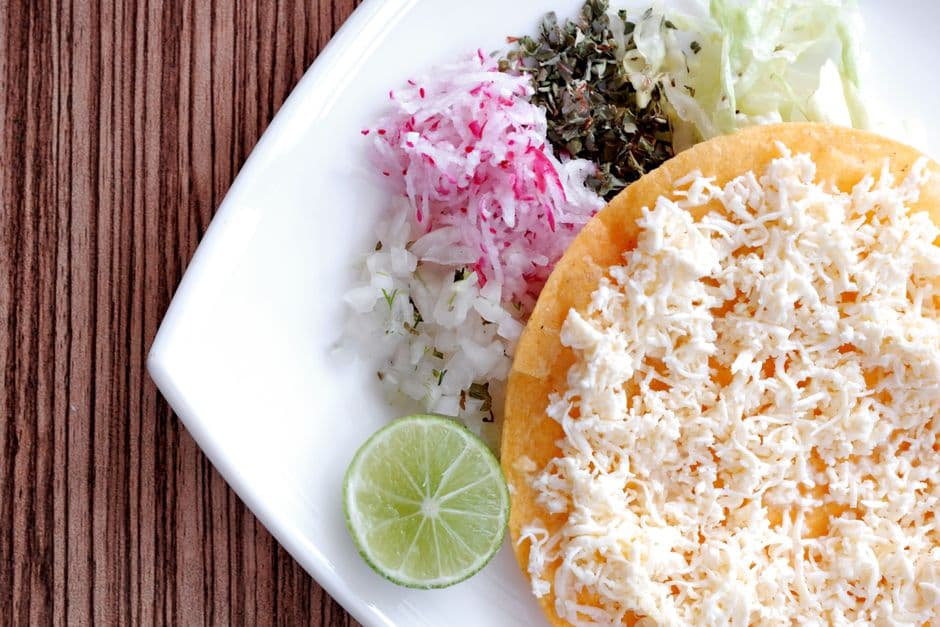
Traditional cooking done seriously. Azul Histórico serves regional Mexican food in the courtyard of an eighteenth century mansion downtown, and it is one of the loveliest rooms in the city for the money. El Bajío out in Azcapotzalco is the reference point for regional home cooking, and you go for the carnitas and the mole. Casa Merlos in San Pedro de los Pinos is where locals send you for Puebla cooking: mole poblano year round and chiles en nogada in season. Bring cash and bring patience.
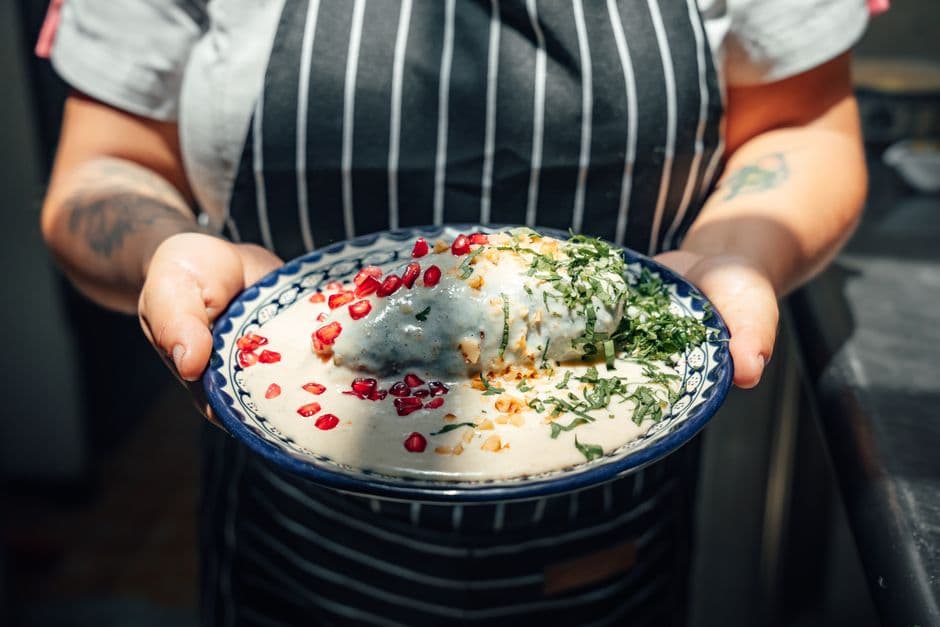
Those chiles en nogada are worth planning around if your dates allow it. A poblano chile stuffed with picadillo, drowned in walnut cream and scattered with pomegranate, it appears roughly from July through September when the walnuts and the pomegranates overlap, and then it goes away. It is the only dish I know that is green, white and red by accident of harvest rather than by design, and every Mexican restaurant will tell you otherwise with a completely straight face.
The cheap meal you will think about later. Casa de Toño in Condesa does pozole at all hours for very little money and is busy at all of them. Café de Tacuba downtown has been open since 1912 and is where you eat tamales and thick chocolate in a tiled room that has seen a century of people doing exactly that. Neither is a destination restaurant. Both are better than most destination restaurants.
The one everyone forgets to book. Máximo in Roma Norte changes its menu daily around whatever came back from the market that morning, holds a star, sat at No. 30 on the 2025 Latin America list, and is still the hardest reservation in the neighborhood. Rosetta, four streets away, is the other one. Neither is a walk in.
Best street food in Mexico City: the cheap layer that stopped being cheap
Around 1,350 searches a month in our file are people looking specifically for street food here, which is a lot of demand for a category that has no addresses and no reservations. Here is the honest version.
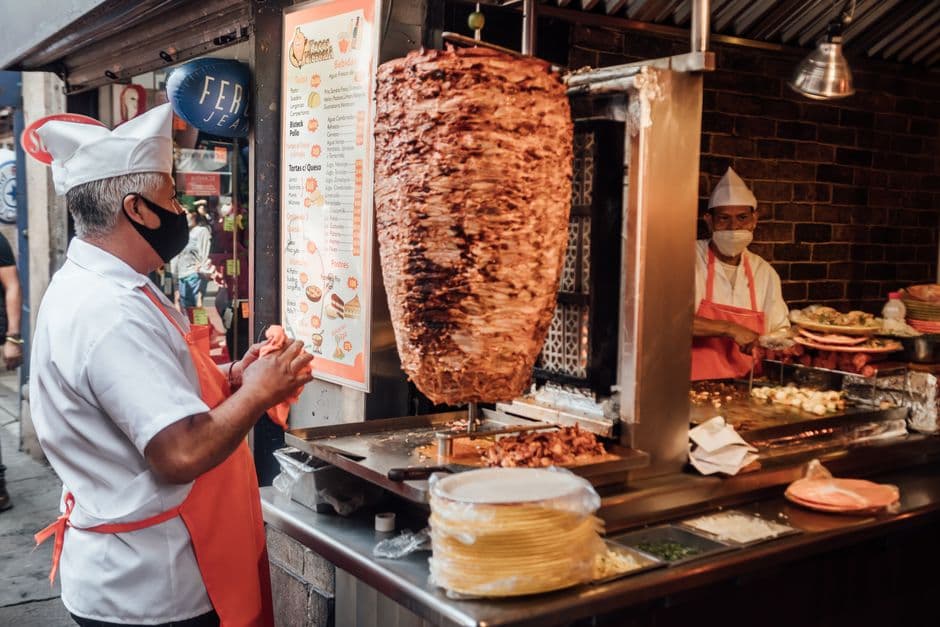
Tacos al pastor are the ones you see on the vertical spit, pork marinated in chiles and achiote, shaved off with a slice of pineapple landing on top if the taquero has the arm for it. The city’s best version is served in places that are not restaurants at all. El Vilsito in Narvarte is an auto repair shop during the day and one of the best al pastor operations in Mexico after dark, running until three in the morning on weeknights and five at weekends. I have no idea how they get the smell of brake fluid out, and I have decided not to investigate.
- El Vilsito, Narvarte. Al pastor, late, in a garage. The gringa is the order.
- Taquería Orinoco. Northern style, several branches, open until half past three in the morning. This is the one you end up at.
- Los Cocuyos, Centro Histórico. A tiny stand for suadero and campechano, cooked in lard, open absurdly late.
- El Turix, Polanco. Yucatán cooking in the middle of the most expensive neighborhood in the city. Cochinita pibil, achiote and sour orange, eaten standing up between people in very good shoes.
And then there is the thing that has changed. Michelin now has a star on a taquería where a taco costs 335 pesos, and the stand it took the star from sells one for a fraction of that. Street food in this city has quietly become a fine dining category with a parallel economy underneath it, and both are worth eating. Just do not let anybody tell you the expensive one is more authentic. It is more expensive. Those are different words.
If you want the wider version of this argument, we have written about the cities where street food is the main event rather than a sideshow.
Where to eat in Mexico City by area: Polanco, Roma Norte, Condesa, Centro
Mexico City is enormous and traffic is worse than the map suggests, so the neighborhood you sleep in decides most of what you eat. Four are worth knowing.
| Area | What it is for | Who it suits |
|---|---|---|
| Polanco | Both two star rooms, Michelin fine dining, expensive and calm | One big dinner, then leave |
| Roma Norte | Six of the eleven starred restaurants, plus Contramar and Rosetta | Base yourself here |
| Condesa | Tree lined, casual, pozole and long breakfasts, walkable at night | Second choice, and cheaper |
| Centro Historico | Cantinas, Cafe de Tacuba, Azul Historico, the late taco stands | Daytime and late night, not evening |
Polanco gets 590 searches a month of its own for restaurant recommendations, which tells you how many people arrive intending to eat exclusively there. It has the two starred flagships and very little else you would cross town for. Go for the dinner, do not sleep there.
Roma Norte is where the actual density is. Rosetta, Contramar, Máximo, Em, Expendio de Maíz and Esquina Común all sit within a short walk, and so do about two hundred places nobody has starred and nobody needs to. If you have four nights and you are not sure where to stay, stay here and stop reading.
Condesa is the quieter version next door, better for breakfast and cheaper for everything, and it has Casa de Toño for the nights when you want pozole and no conversation. Centro Histórico is a daytime and a very late night neighborhood rather than an evening one: Café de Tacuba, Azul Histórico and the courtyard restaurants during the day, Los Cocuyos and the cantinas after midnight, not a great deal in between.
The two o'clock rule, and why your dinner reservation is the wrong meal
This is the thing that catches out visitors more than altitude, spice or anything else, and almost nobody puts it near the top of a guide.
The main meal here is in the afternoon. La comida runs from about two until five, it is often three courses, it frequently takes two hours, and it is the meal a Mexican kitchen is actually built around. Arrive at a good restaurant at one and you will have the room to yourself, which feels like a win for about four minutes and then feels like eating in a furniture showroom.
Dinner, la cena, is the small one. Locals start around nine. Kitchens in the center generally serve until eleven on a weeknight and later at weekends, so a nine thirty table is normal rather than late.
- Book the good restaurants for lunch, not dinner. Contramar at two in the afternoon is a completely different and better restaurant than Contramar at eight in the evening. The same is true of most of the traditional kitchens on this list.
- Do not schedule anything for four in the afternoon. You will still be at lunch. Everyone is still at lunch.
- Eat the tacos after ten. The al pastor spit needs hours to be worth queueing for, and the taquerías that matter are barely awake before then.
- Breakfast is real and it is large. Chilaquiles, eggs, beans, and enough of it that skipping lunch becomes tempting. Do not skip lunch. See above.
Get the rhythm right and the city opens up. Get it wrong and you spend a week eating good food in empty rooms at the hours nobody local would choose, then go home and tell people Mexico City was quieter than you expected.
Booking, tipping, and the small print worth knowing
Nothing here is complicated, but all of it costs you something if you get it wrong on the first night.
- Book the star rooms before you fly. Pujol wants months. Quintonil and Rosetta want weeks. Máximo and Contramar want days and will still tell you no on a Saturday.
- Tip in pesos, ten to twenty percent. Check the bill first for the words propina or servicio, because some places add it, and paying it twice is a donation rather than a gesture. Tipping in dollars makes it harder for the person receiving it, not easier.
- Cash for the stands and some of the classics. Casa Merlos and most taquerías are cash operations. Anything with a star takes a card.
- Split the fine dining across the trip. Two tasting menus in three days is a lot of tweezers. Alternate with a market lunch and you will enjoy both more.
- Day trip to Oaxaca if you have the time. It is the other Mexican food city that Michelin covers, and it is a genuinely different cuisine rather than a variation. We have a list for that too.
One last thing about those eleven stars. The guide has been in Mexico for three years, it has already reversed itself once on the most famous taco in the country, and the region’s other big list has just dropped the restaurant that started all of it. If you were waiting for the rankings to settle before you booked a trip, I have some bad news about the rankings, and some very good news about the tacos.
Go eat at two in the afternoon like a person who lives here. Order the fish split down the middle, half red and half green, so you do not have to choose. Then go find a garage that sells pork at midnight, and see whether you can tell which one had the star.
Eating your way across more of Mexico? The rest are on our destinations page, the full Mexico City restaurants list is the one to start with here, and if you are keeping score on stars we also worked out which city actually has the most of them.
Common questions
- What are the best restaurants in Mexico City?
- Sort them by what you want rather than by rank. Pujol and Quintonil in Polanco are the two Michelin starred rooms and need booking well ahead. Contramar in Roma Norte is the long seafood lunch everybody who lives here recommends, and it has no star at all. Rosetta is the one star room in a Roma Norte mansion and the most searched restaurant in the city. Maximo changes its menu with the market daily. For traditional cooking go to Azul Historico downtown, El Bajio in Azcapotzalco or Casa Merlos in San Pedro de los Pinos. For cheap and excellent, Casa de Tono for pozole and Cafe de Tacuba for tamales.
- How many Michelin star restaurants are there in Mexico City?
- Eleven in the MICHELIN Guide Mexico 2026 selection, revealed on 20 May 2026. Two hold two stars, Pujol and Quintonil, both in Polanco. Nine hold one star: Em, Esquina Comun, Expendio de Maiz, Gaba, La Once Mil, Masala y Maiz, Maximo, Rosetta and Sud 777. There are no three star restaurants in Mexico. Across the whole country the 2026 selection counts 29 starred restaurants.
- Why did El Califa de Leon lose its Michelin star?
- Michelin does not publish reasons for a demotion. What is on the record is that El Califa de Leon, the taqueria on Avenida Ribera de San Cosme in San Rafael, became the first taco stand in the world to hold a star on 15 May 2024, kept it in 2025, and lost it in the 2026 selection announced on 20 May 2026. It was the only restaurant in that edition to be demoted, and it stays in the guide as a recommendation. The 2026 star went instead to La Once Mil, a taqueria in Lomas de Chapultepec where a taco can cost 335 pesos.
- What is the best street food in Mexico City?
- Tacos al pastor first, carved off a vertical spit of chile and achiote marinated pork. El Vilsito in Narvarte is an auto repair shop by day and one of the best al pastor stands in the country after dark, open until three in the morning on weeknights. Taqueria Orinoco does northern style tacos until half past three. Los Cocuyos in the Centro Historico is the late night stand for suadero and campechano. El Turix in Polanco does Yucatecan cochinita pibil. Go after ten at night, when the spits have had time to work.
- What is the best food in Mexico City?
- Tacos al pastor, tuna tostadas, mole in one of its regional forms, pozole, chilaquiles for breakfast, and cochinita pibil if you can find a Yucatecan kitchen. If you are there between roughly July and September, add chiles en nogada: a poblano chile stuffed with picadillo under a walnut cream sauce with pomegranate seeds, which only exists while both harvests overlap.
- What are the best restaurants in Polanco, Mexico City?
- Polanco is where both of the city's two star restaurants are. Pujol, Enrique Olvera's flagship, and Quintonil, run by Jorge Vallejo, sit a short walk apart, so you can do both in one trip without a car. El Turix in the same neighborhood is the opposite end of the range, a tiny Yucatecan taco counter. Polanco is worth crossing town for dinner and is not the best place to base yourself for the rest of your eating.
- What time do people eat in Mexico City?
- The main meal, la comida, runs from about two in the afternoon until five and is often three courses over a couple of hours. Dinner, la cena, is the small meal and locals start around nine, with kitchens in the center serving until about eleven on a weeknight and later at weekends. Book the good restaurants for lunch rather than dinner, and leave the tacos until after ten.
- Do you need to book restaurants in Mexico City?
- For the starred rooms, yes, and before you fly. Pujol takes reservations months ahead. Quintonil and Rosetta want weeks. Maximo and Contramar can sometimes be done a few days out and will still turn you away on a Saturday. Taquerias, market stalls and the cheap classics take nobody's name and never need one.
- Is Pujol still the best restaurant in Mexico City?
- It depends which instrument you ask, and in 2026 they disagree. Pujol still holds two MICHELIN stars, one of only two restaurants in Mexico to do so. But in the Latin America's 50 Best Restaurants 2025 list, announced on 15 December 2025, it fell out of the top fifty for the first time in over a decade, placing 51st after ranking 24th the previous year. Quintonil came 7th on that list, Maximo 30th and Rosetta 39th.
- Where should I stay in Mexico City to eat well?
- Roma Norte. Six of the city's eleven starred restaurants are in or beside it, along with Contramar and Rosetta, and it is walkable end to end. Condesa next door is quieter and cheaper and good for breakfast. Polanco has the two star flagships and little else worth walking to. The Centro Historico is a daytime and very late night neighborhood rather than an evening one.