
Best Food in Osaka, Japan: The Three-Star Counters, the 1935 Takoyaki and Where to Eat
Every guide to Osaka opens with the same word: kuidaore, eat until you drop. Fair enough. It is also the least useful thing you can know about the city, because it tells you to eat a lot and nothing about what to eat. Here is the more useful fact. Osaka holds three three-star MICHELIN restaurants, and it also invented, on the record and with a date attached, two of the foods you will eat standing up for under a thousand yen. Plan for both ends. The middle takes care of itself.
The short version, for anyone already hungry. For the once-in-a-decade dinner, Taian, Kashiwaya or Hajime, the city's three three-stars. For the best modern French in Japan by at least one ranking, La Cime. For the food Osaka actually gave the world, takoyaki in Namba and kushikatsu in Shinsekai. Everything below is how to choose, and one correction the internet keeps getting wrong.
MICHELIN-starred restaurants in Osaka
Osaka is not a MICHELIN footnote to Kyoto. The 2026 Kyoto Osaka guide, announced on 23 April 2026, gives Osaka 3 three-star restaurants, 12 two-stars and 66 one-stars, plus 59 Bib Gourmands for good cooking at a moderate price. That is 81 starred restaurants in one city. Most European capitals would take that number and frame it.
| Restaurant | Stars | Cooking |
|---|---|---|
| Taian | 3 | Kaiseki |
| Kashiwaya Osaka Senriyama | 3 | Kaiseki |
| Hajime | 3 | Innovative |
| La Cime | 2 | Modern French |
| Koryu | 2 | Kaiseki |
| Teruya | 2 | Promoted in 2026 |
The three at the top have not changed. Time Out Osaka put it plainly after the 2026 ceremony: Taian, Kashiwaya Osaka Senriyama and Hajime "remain the only three establishments with the highest star ranking." Kashiwaya's Hideaki Matsuo also took the guide's Mentor Chef Award this year, which is MICHELIN's way of saying the other kaiseki kitchens in town learned from him.
Here is the part worth knowing before you book, because the internet has it wrong in two directions at once.
- Taian is three-star, not "starred". Plenty of lists describe it as a restaurant with a MICHELIN star, which is true in the way that describing Everest as a hill with some snow is true. Hitoshi Takahata's counter holds three, the maximum.
- Koryu is two-star, not one. It is still listed as a one-star in a surprising number of places. MICHELIN's own entry for it says two.
- La Cime was never Asia's number one. Yusuke Takada's two-star French restaurant ranked No. 8 on Asia's 50 Best in 2023, the year Le Du in Bangkok took the top spot. In 2026 it ranked No. 13, the highest of any restaurant in Japan, and the first time a restaurant outside Tokyo has held that position. That is a better story than the made-up one, and it has the advantage of being true.
The lesson generalizes. A star count is a fact with a date on it, and most of what you read online is a fact whose date has expired. When the booking costs what a three-star booking costs, check the current guide yourself.
The food Osaka invented, with the dates
Most cities claim a dish. Osaka can prove two, and the proof is still open for lunch.
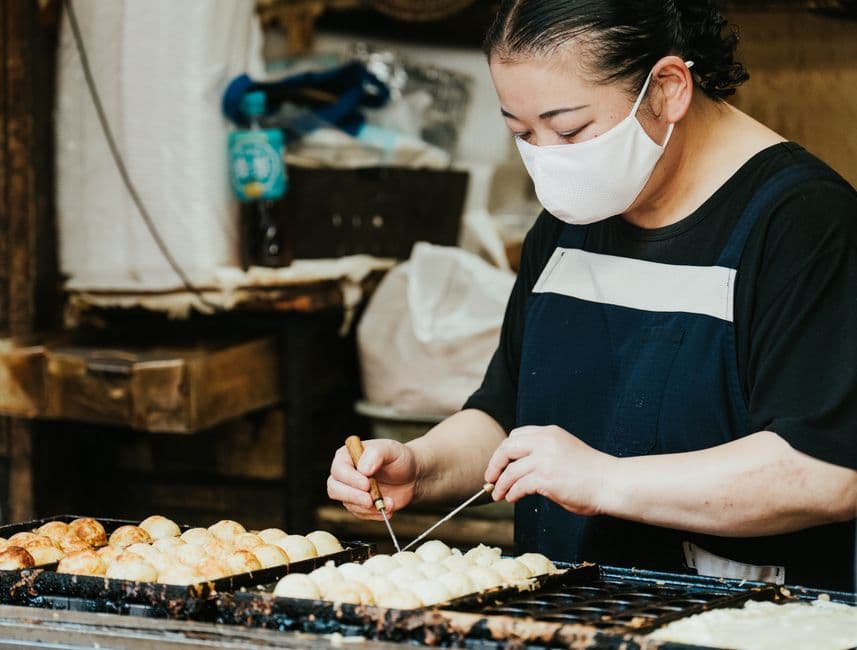
Takoyaki, 1935. Per the standard history, a street vendor named Tomekichi Endo is credited with inventing it in Osaka in 1935, developing earlier batter snacks that held beef or konjac. His shop, Aizuya, named after his hometown, still exists and still serves the original: no sauce, no mayonnaise. Eat one there first. Then eat the sauced version in Dotonbori and decide for yourself whether eighty years of toppings were an improvement.
Kushikatsu, 1929. Skewered, breaded and deep-fried meat and vegetables, traced to a small food bar in Shinsekai run since 1929. It comes with one rule that every visitor learns within about a minute: the sauce pot is shared, so you dip once. Never twice. If you need more sauce, scoop it with a leaf of the free cabbage and pour it on. This is not etiquette for its own sake. It is hygiene with a sign on the wall.
The mechanism behind both is the same. Osaka was a merchant city, and merchants eat fast, cheap and often. Street food here was never the lesser option. It was the main one.
Where to eat in Osaka, by neighborhood
Pick the neighborhood by the meal, not the other way round. The difference between Kitashinchi and Shinsekai is not a price bracket, it is a different city.
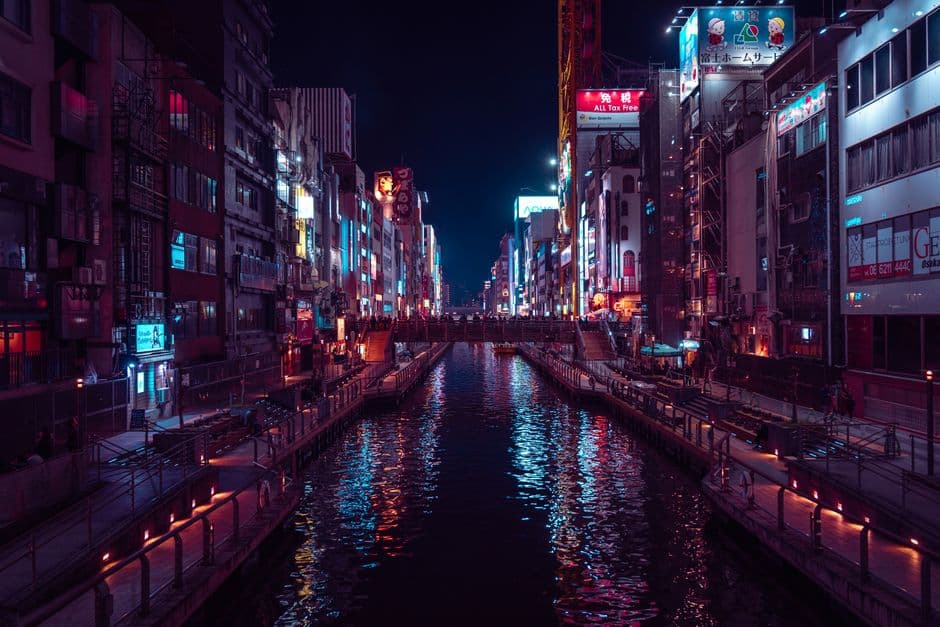
- Namba and Dotonbori. The neon canal, the giant crab, the takoyaki stands. Touristy, yes, and still where the street food is best, because the competition is brutal and the queues are honest.
- Shinsekai. Kushikatsu under the Tsutenkaku tower. Loud, cheap and slightly retro on purpose. Go hungry, go at night.
- Kitashinchi. The expense-account district. Sushi counters with eight seats and no prices on the menu, which is itself the price.
- Honmachi and Kitahama. The business district, and quietly the fine-dining district. La Cime and Koryu both cook within a few minutes of here.
- Tenma. Standing bars and izakaya around Tenjinbashisuji, one of the longest shopping streets in Japan. The best area for eating the way people who live here eat after work.
How to eat out in Osaka
- Book the stars far ahead, and through someone. Several of the top counters are hard to reach directly and take reservations through a hotel concierge or a booking service. Start a month out, more for the three-stars.
- Do not tip. Japan does not tip, and leaving money on the table causes a small, polite chase down the street.
- Carry cash for street food. The starred restaurants take cards. The takoyaki stand might not.
- Queue. A line outside is the most reliable review in the city. A place with no line at 7pm on a Friday is telling you something.
- Eat in small rounds. A plate of takoyaki is eight balls. Share it, walk ten minutes, eat something else. That is kuidaore done properly, and it is the one time the famous word is actually useful.
If your trip continues to Tokyo, the Tokyo list is built the same way. For how Osaka compares with the world, see the best food cities in the world and which city has the most MICHELIN stars. Every other city is on the destinations page.
Searching for Osaka food? Add Japan
A search for an Osaka restaurant will very often not return anything in Osaka. We counted: across 64 common search phrases pairing Osaka with food or restaurants, worth about 61,000 searches a month between them, roughly 86 percent of that volume is about somewhere else. Most of it is American restaurants named Osaka: hibachi grills, sushi buffets and Japanese express counters from Tulsa to Fargo. Hibachi and the all-you-can-eat buffet are American formats, which is how you can tell. A smaller share is a restaurant called Osaka in Lima, Peru.
The fix is one word. Add Japan, or search a neighborhood such as Namba or Kitashinchi by name, and the results stop sending you to a strip mall in the Midwest.
Best food in Osaka, Japan: common questions
What is the best food in Osaka, Japan? The two dishes Osaka invented, takoyaki and kushikatsu, plus okonomiyaki. For fine dining, the three-star kaiseki at Taian and Kashiwaya, the three-star innovative cooking at Hajime, and two-star La Cime.
How many MICHELIN-starred restaurants are in Osaka? In the 2026 guide, 81: three with three stars, twelve with two and sixty-six with one, plus 59 Bib Gourmands.
Which Osaka restaurants have three MICHELIN stars? Taian, Kashiwaya Osaka Senriyama and Hajime.
Where was takoyaki invented? In Osaka, in 1935, by a street vendor named Tomekichi Endo. His shop, Aizuya, still serves it the original way, without sauce.
Which neighborhood in Osaka is best for food? Namba and Dotonbori for street food, Shinsekai for kushikatsu, Kitashinchi for sushi, Tenma for izakaya.
Do you tip at restaurants in Osaka? No. Tipping is not part of dining in Japan, at any price level.
Eat one three-star dinner and ten street snacks, in that ratio. The famous meals in Osaka are the expensive ones. The memorable ones cost about six hundred yen. The Osaka list has both.
Best food in Osaka, Japan: common questions
- What is the best food in Osaka, Japan?
- The two dishes Osaka invented, takoyaki and kushikatsu, plus okonomiyaki. For fine dining, the three-star kaiseki at Taian and Kashiwaya, the three-star innovative cooking at Hajime, and two-star La Cime.
- How many Michelin star restaurants are in Osaka?
- In the 2026 MICHELIN Guide Kyoto Osaka, 81: three with three stars, twelve with two and sixty-six with one, plus 59 Bib Gourmands.
- Which Osaka restaurants have three Michelin stars?
- Taian, Kashiwaya Osaka Senriyama and Hajime.
- Where was takoyaki invented?
- In Osaka, in 1935, by a street vendor named Tomekichi Endo. His shop, Aizuya, still serves it the original way, without sauce or mayonnaise.
- Which neighborhood in Osaka is best for food?
- Namba and Dotonbori for street food, Shinsekai for kushikatsu, Kitashinchi for sushi and Tenma for izakaya.
- Do you tip at restaurants in Osaka?
- No. Tipping is not part of dining in Japan, at any price level.